Malwarebytes built its reputation as the free cleanup tool that found what your main antivirus missed. That product is mostly gone. Today it is a paid subscription that quietly renews at higher prices than the introductory rate, with no advance notice, no phone support line, and a Trustpilot rating that has settled at 3.3 out of 5. Forums and community threads that once recommended it by default now routinely ask: is Malwarebytes still worth it?
The independent lab data validates the frustration. In AV-Comparatives Real-World Protection Testing (July-October 2025, 428 test cases), Malwarebytes triggered 42 false positives – nearly four times the industry average – and received only the lowest-tier “Tested” award while competitors earned the top Advanced+ rating with 99-100% detection. In hands-on testing, it pegs CPU at 100% during full disk scans, idles at 150-200 MB of RAM with spikes to 1.5 GB under load, and still ships with no built-in firewall, no parental controls, and no backup or restore. For what it charges at renewal, those are hard gaps to justify.
We compared eight alternatives that replace Malwarebytes entirely rather than supplement it: a full security suite with built-in firewall and fixed renewal pricing, top-tier detection backed by independent labs, and free Windows-native protection that outperformed Malwarebytes in the same test window. Here is how they compare at a glance.
| Tool | Price/yr | Lab Detection Rate | Best For |
|---|---|---|---|
| MalwareFox | $39 (1 device) | 99.9%* (Advanced) | Security focused Suite, Malwarebytes replacement |
| Bitdefender Total Security | ~$49.99 (5 devices) | 99.1–99.97% (Advanced+) | All-in-one family protection |
| Norton 360 | $29.99–$99.99 | 100% (Advanced+) | Detection + identity protection |
| ESET NOD32 | ~$39.99 (1 device) | 99.1% (Advanced+) | Low system impact / gamers |
| TotalAV | $19–$49 (3-6 devices) | 99.7% (AV-Test) | Budget multi-device coverage |
| Emsisoft Anti-Malware | ~$39.99 (1 device) | – | Layered dual-engine scanning |
| HitmanPro.Alert | ~$34.95 (1 device) | – | Second-opinion scanner |
| Windows Defender | Free | 99.1% (Advanced+) | Free built-in protection |
**Protection rate based on the AV-Comparatives Malware Protection Test of MalwareFox’s core K7 detection engine.
Each pick below includes real pricing, lab data where available, and a clear verdict so you can match the right tool to your situation.
1. MalwareFox
While Malwarebytes sits at 150-200 MB idle and can spike to an aggressive 1.5 GB during scans, MalwareFox idles at just 100 MB with under 1% CPU usage. The difference shows on older hardware and mid-session gaming. More importantly, Malwarebytes has no built-in firewall. MalwareFox does.
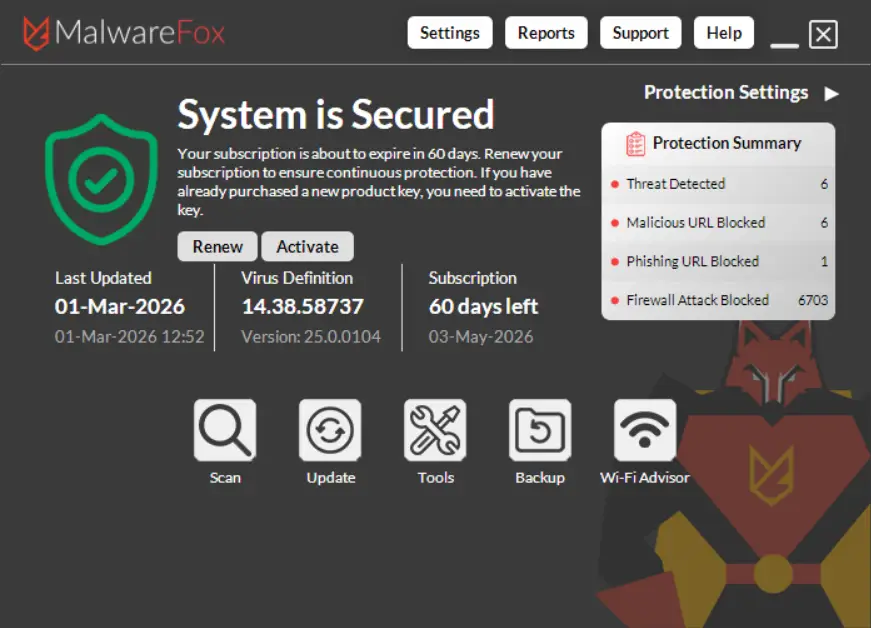
Its ZeroHour AI detection engine targets zero-day threats, the kind of attacks that slip past traditional signature-based scanning. The underlying K7 engine scored 99.9% in the AV-Comparatives Malware Protection Test (September 2025, 9,995 samples), earning the Advanced award – with only 8 false positives against an industry average of 11.
Dedicated browser hijacker removal handles a category Malwarebytes ignores entirely. If your homepage keeps changing or unwanted toolbars keep reappearing, this is the tool built specifically for that problem.
Ransomware protection includes a secure backup and restore feature, so your important files can be recovered even if encryption starts. MalwareFox is a full security suite, not a companion scanner. It replaces Malwarebytes or Windows Defender as your primary protection. Bundled tools include a Browser Cleaner, USB Vaccination to block autorun threats, WiFi Advisor for network security checks, and additional cleanup utilities. Android mobile protection is included as well.
Pricing: $39/yr for one device, $59/yr for three, $79/yr for five. The price you sign up for is the price you keep. No renewal hikes. A 60-day money-back guarantee gives you two full months to test it.
Pros:
- Built-in firewall (absent from Malwarebytes entirely)
- K7 engine: 99.9% detection rate, only 8 false positives (AV-Comparatives, Sep 2025)
- Dedicated browser hijacker removal not found in competing products
- Secure backup and restore for ransomware recovery
- Full suite: Browser Cleaner, USB Vaccination, WiFi Advisor, cleanup tools
- Fixed renewal pricing with no surprise increases
Cons:
- Lab results published under K7 branding, not MalwareFox directly – a labeling distinction, not a detection gap
- No bundled VPN or identity theft monitoring – MalwareFox focuses entirely on security and privacy rather than bundling unrelated services
The verdict: MalwareFox is the best Malwarebytes alternative for users who want honest, focused security. Its engine delivers 99.9% detection with a fraction of the false positives Malwarebytes triggers, it ships with a firewall Malwarebytes still lacks, and the price you sign up for is the price you keep – no upsells, no fake alerts, no renewal surprises.
2. Bitdefender Total Security
Bitdefender earned the Advanced+ award from AV-Comparatives with detection rates between 99.1% and 99.97%, placing it firmly in the top tier of tested products. Where Malwarebytes leaves gaps, Bitdefender fills every one of them.
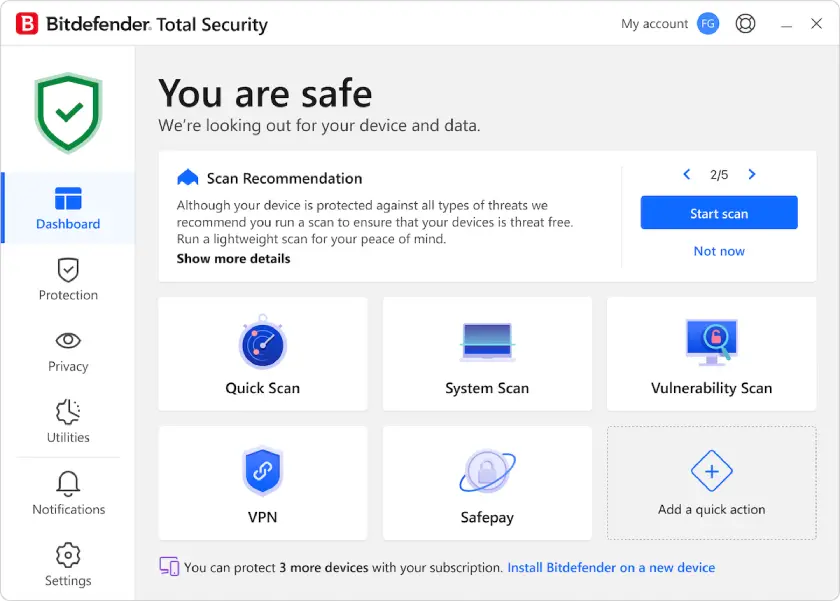
Multi-layer ransomware remediation protects your files from encryption attacks. A built-in firewall, parental controls, and password manager come standard. VPN access is included at 200 MB per day on the base plan, with unlimited bandwidth available on the premium tier. Cross-platform support covers Windows, Mac, Android, and iOS.
The per-device value stands out. Bitdefender Total Security runs about $49.99/yr for five devices. Malwarebytes charges $59.99/yr for three. That means Bitdefender protects more devices for less money while delivering a far more complete feature set. For families managing a mix of laptops, phones, and tablets, a single Bitdefender subscription replaces what would otherwise require multiple separate tools.
Pros:
- Near-perfect independent lab scores (99.1-99.97% detection)
- Full suite: firewall, parental controls, password manager, VPN
- Strong per-device pricing at five devices
- Cross-platform coverage on Windows, Mac, Android, and iOS
Cons:
- VPN capped at 200 MB/day unless you upgrade
- Interface can feel complex for non-technical users
The verdict: Bitdefender Total Security is the strongest all-in-one family suite on this list – top-tier detection, five devices, and every feature Malwarebytes is missing, all under one subscription.
3. Norton 360
Norton achieved a 100% detection rate across all 428 test cases in the AV-Comparatives Real-World Protection Test and earned the Advanced+ award. No other product on this list matched that perfect score.
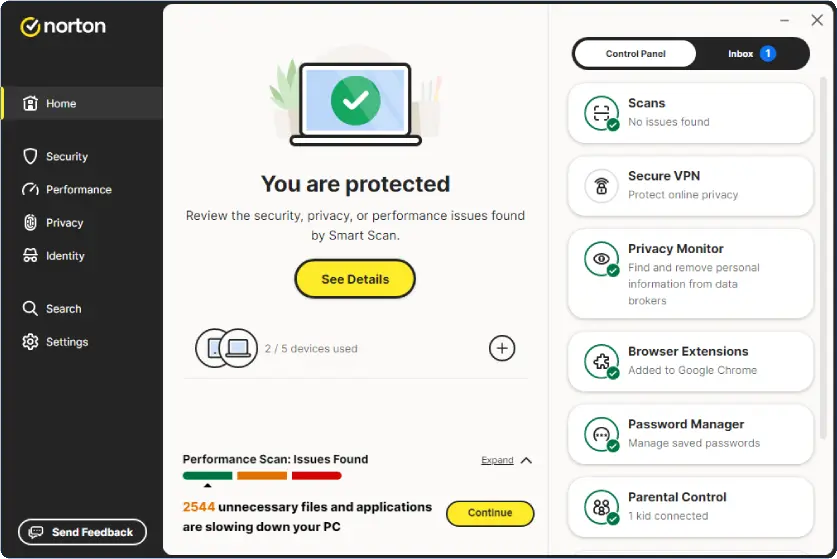
Beyond raw detection, Norton bundles features that go well beyond traditional antivirus. A built-in firewall, identity theft protection, and 50 GB of cloud backup come with mid-tier plans. The unlimited VPN is available on premium tiers. Dark web monitoring scans for your personal data appearing in known breaches, alerting you when your email addresses, passwords, or financial details surface on underground marketplaces.
Pricing ranges from $29.99/yr for a single device up to $99.99/yr for unlimited devices with full family features. The entry price is competitive, though renewal rates do increase after year one. Factor the long-term cost into your decision before signing up.
Pros:
- Perfect 100% detection rate in independent testing
- Identity theft protection bundled in
- Generous 50 GB cloud backup
Cons:
- Higher renewal prices after the first year
- Heavier system footprint than lighter alternatives
If you want the highest detection rate available and value identity protection as part of your security stack, start with Norton 360 Standard at $29.99/yr and upgrade as needed.
4. ESET NOD32
Malwarebytes can consume up to 1.5 GB of RAM during scans. For gamers mid-session or anyone running an older machine, that kind of resource spike is not just annoying but disruptive. ESET NOD32 was built for exactly this scenario.
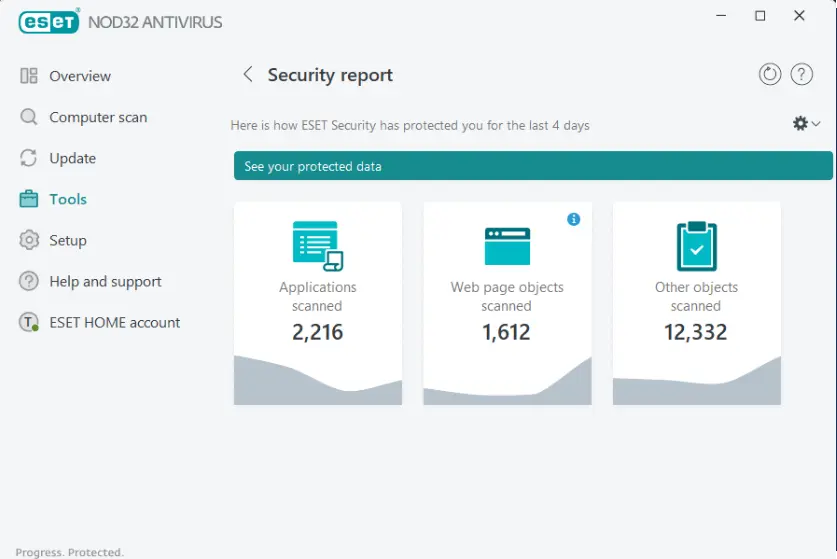
ESET scored 99.1% detection in AV-Comparatives testing and earned the Advanced+ award, putting it in the same top tier as Bitdefender and Norton. Its Host-based Intrusion Prevention System (HIPS) monitors system behavior to catch threats that signature scans miss. A dedicated Gamer Mode suppresses all notifications and background tasks during full-screen applications.
RAM usage sits around 250-300 MB, moderate compared to the lightest options but with far less scan-time impact than Malwarebytes. Pricing is straightforward at roughly $39.99/yr for a single device.
Pros:
- Excellent detection with Advanced+ certification
- Gamer Mode suppresses interruptions during full-screen apps
- Advanced HIPS behavioral monitoring
Cons:
- No free tier available
- Fewer bundled extras than Bitdefender or Norton
Best for gamers and performance-sensitive users who need proven protection without system slowdowns. Skip if you want a bundled VPN or parental controls included in the package.
5. TotalAV
TotalAV starts at $19/yr for three devices. That works out to about $6.33 per device. Malwarebytes charges $59.99/yr for three devices, roughly $20 each. For families protecting multiple computers, phones, and tablets, that difference adds up fast.
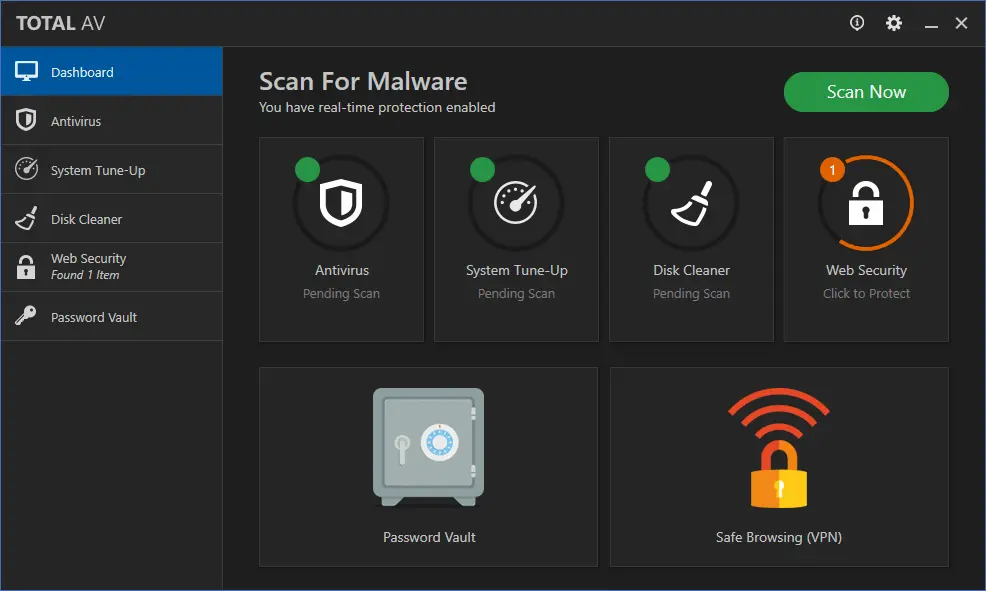
TotalAV’s Smart Scan can detect malware hidden inside archived and compressed files, catching threats that standard quick scans often miss. Phone support is included with all plans, a rarity at this price point. The product holds a 9.3 out of 10 SecurityScore from security.org. Plans scale from $19/yr for three devices up to $49/yr for six.
Pros:
- Lowest price on this list
- Multi-device friendly with plans covering up to six devices
- Phone support included at all tiers
Cons:
- Mixed results in independent lab reviews
- Aggressive upselling during installation
- Renewal prices may increase after the introductory period
Quick comparison vs. Malwarebytes: At roughly one-third the per-device cost, TotalAV delivers comparable protection for families who do not need advanced features like behavioral analysis or browser hijacker removal. Pair it with a free second-opinion scanner like HitmanPro’s trial to close any detection gaps.
6. Emsisoft Anti-Malware
What if your antivirus ran two detection engines at once? Emsisoft does exactly that. It operates its own proprietary scanning engine alongside Bitdefender’s engine in parallel, giving you two independent layers of detection in a single product.
A Behavior Blocker monitors all running processes in real time, catching suspicious activity that signature-based scanning might miss. Dedicated anti-ransomware protection is included, along with browser security extensions that guard against malicious websites. Pricing sits at about $39.99/yr for one device.
The trade-off is resource usage. Emsisoft idles at around 300 MB of RAM, higher than MalwareFox or ESET. That is the cost of running two engines simultaneously. There is no built-in VPN.
Pros:
- Dual-engine detection catches what a single engine might miss
- Behavior-based blocking monitors running processes
- Dedicated anti-ransomware layer
Cons:
- Higher memory footprint than single-engine alternatives
- No built-in VPN
The verdict: Emsisoft is the paranoid option, in the best sense. Two engines running in parallel means two chances to catch every threat. If layered detection matters more to you than a light footprint, this is your pick.
7. HitmanPro.Alert
You do not always need to replace Malwarebytes. Sometimes you just need a second pair of eyes scanning for what your primary antivirus missed. HitmanPro.Alert fills that role better than any other tool on this list.
It uses cloud-based scanning powered by Kaspersky and Bitdefender engines, two of the highest-rated detection technologies in the industry. Because the heavy lifting happens in the cloud, the local system impact stays minimal. Behavioral analysis adds a second detection method, catching threats that traditional signature scans overlook.
CryptoGuard provides real-time ransomware detection and automatic rollback, reversing file encryption as it happens. A 30-day free trial lets you test everything before committing. After that, pricing runs about $34.95/yr for a single device.
Pros:
- Leverages two top-tier cloud engines (Kaspersky + Bitdefender)
- Lightweight thanks to cloud-offloaded scanning
- Excellent complement to any existing antivirus
Cons:
- Not a standalone antivirus solution
- Single-device license only
If you want to keep your current antivirus but add a reliable safety net, start with HitmanPro’s 30-day free trial. It takes minutes to install and runs quietly alongside whatever you already have.
8. Windows Defender
The idea that Windows Defender is weak or unreliable is outdated. Microsoft has invested heavily in its built-in security over the past several years, and the results show in recent independent testing.
Windows Defender comes pre-installed and active on every Windows 10 and Windows 11 PC. Real-time protection runs automatically. Controlled Folder Access blocks unauthorized apps from modifying files in your Documents, Pictures, and other key folders. The Windows Security dashboard integrates firewall management, device health monitoring, and family safety options in one place.
There is no subscription, no installation, and no upselling. It simply works out of the box. For users who want a free Malwarebytes alternative with zero configuration, Defender handles the basics well.
Pros:
- Completely free and pre-installed
- Integrated firewall and ransomware protection
- No bloatware, no upsells, no renewal fees
Cons:
- Windows-only with no cross-platform support
- Phishing protection limited to the Microsoft Edge browser
Best for users who want set-and-forget free protection with zero setup. Skip if you need cross-platform coverage across Mac, Android, and iOS, or advanced features like VPN and identity monitoring.
FAQ
Is Malwarebytes good enough for home users in 2026?
Malwarebytes is still effective at removing existing malware infections, but it falls short as standalone protection. It lacks a firewall, VPN, and parental controls. Its 98.1% detection rate with 42 false positives earned only the lowest-tier “Tested” award from AV-Comparatives.
What is the best free alternative to Malwarebytes?
Windows Defender is the strongest free option. It comes pre-installed, runs in real time, and includes ransomware protection via Controlled Folder Access. MalwareFox Free provides limited on-demand scanning for users who want a quick second-opinion check.
Is MalwareFox better than Malwarebytes?
MalwareFox includes a built-in firewall, browser hijacker removal, USB Vaccination, and secure ransomware backup and restore – none of which Malwarebytes offers. It costs $39/yr with fixed renewal pricing versus Malwarebytes’ $44.99/yr with potential increases. Furthermore, while Malwarebytes struggles with high false positives in independent testing, MalwareFox’s K7 engine consistently earns top-tier Advanced awards from AV-Comparatives.
Can I use a Malwarebytes alternative alongside Windows Defender?
Yes, some tools like HitmanPro.Alert are built to run alongside Windows Defender as companion scanners. However, full security suites like MalwareFox are designed to be your primary antivirus. When you install MalwareFox, it automatically replaces Windows Defender to provide complete, centralized protection without system conflicts.
Does Malwarebytes slow down your computer?
Malwarebytes uses 150-200 MB of RAM at idle and can spike to 1.5 GB during active scans. For lighter alternatives, MalwareFox idles at roughly 100 MB, and ESET NOD32 sits around 250-300 MB with minimal scan-time disruption. Both are better choices for older hardware or gaming PCs.
PLEASE OFFER PRICE COMPARISONS AS WELL!